.svg)

What Causes Brown Spots on My Grass? Common Causes and What They Mean
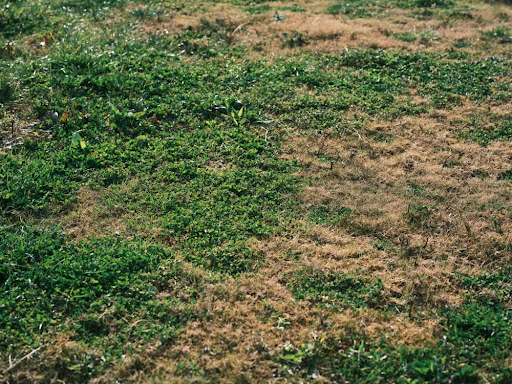
Brown spots form when heat, uneven watering, lawn disease, grubs, pet urine, fertilizer stress, root problems, or repeated traffic damages the grass leaves, crowns, or roots. The crown is the growing point near the soil surface.
The pattern provides the first clue. Curved areas often follow water coverage, small circles with dark green edges suggest pet urine, and straight strips may follow an application path. In Utah, cool-season grasses, dry summers, clay-heavy soil, and salt buildup can make the same areas turn brown repeatedly.
Key Takeaways
- Blue-gray grass often appears before drought-related browning.
- Curved or wedge-shaped patches commonly point to uneven water coverage.
- Loose grass and missing roots suggest grub activity.
- Fast-forming straw-colored areas may indicate Ascochyta leaf blight.
- Recurring rings can point to summer patch or necrotic ring spot.
- Spots that return in the same footprint often involve roots, drainage, soil depth, or compaction.
What Brown Spots Can Tell You About Your Lawn
Here are some clues that can tell you about the brown spots in the lawn. The condition of the roots and crowns often confirms the cause.
Common Causes of Brown Spots on Grass
Heat and Drought Stress
Heat and drought stress create brown spots when grass loses water faster than its roots can replace it. Early signs include blue-gray grass, folded leaves, and lasting footprints. Continued stress leads the grass to turn brown. If you're unsure whether brown grass is dormant or dead, see our guide on how to tell the difference between dormant and dead grass.
Damage is often worse:
- Near heat-retaining pavement
- On slopes where water runs off
- Where shallow soil, compaction, thatch, or buried materials restrict roots
Tall fescue has deeper roots and generally handles heat better than Kentucky bluegrass, which may fade sooner during Utah’s hot, dry periods. Firmly anchored brown grass may be dormant, while damaged crowns or roots indicate slower recovery.
Watering Problems
Watering problems create brown spots when water misses part of the lawn, runs off before reaching the roots, or remains in the soil too long.
The shape often shows what is happening:
- Curved or wedge-shaped patches may match a sprinkler’s reach.
- Brown areas on slopes may result from runoff.
- Wet low spots suggest poor drainage and low oxygen around the roots.
- Green and brown grass side by side may reflect a change in water coverage or soil depth.
Soil with more than 30% clay slows water entry and air movement. The surface may look dry while the soil below remains saturated, or it may look wet even though little water has reached deeper roots.
Lawn Diseases
Lawn disease symptoms create brown spots by damaging the leaves, crowns, or roots. Common lawn diseases include:
- Ascochyta Leaf Blight: Ascochyta leaf blight can make large areas turn straw-colored very quickly. The leaf tips die back about one-third to one-half of the blade. The fungus develops during cool, wet weather, but symptoms usually appear when temperatures quickly rise to 85°F–95°F, causing rapid leaf damage while crowns and roots remain alive.
- Summer Patch: Summer patch forms brown circles or arcs after damaging the roots and crowns. Patches may range from several inches to several feet across.
- Necrotic Ring Spot: Necrotic ring spot begins as small, light-green patches that enlarge to about 1–3 feet as the roots and crowns weaken. Grass may recover in the center, creating a ring or frog-eye pattern.
Grub and Billbug Activity
Grubs create irregular yellow or brown patches in the lawn by feeding on grass roots. The strongest clue is how firmly the grass remains anchored. Drought-stressed grass usually stays attached, while severe grub damage leaves shortened or missing roots.
Visible damage can begin at different grub counts:
- May/June beetle grubs: 3–5 per square foot
- Masked chafer grubs: 8–10 per square foot
- Black turfgrass ataenius grubs: 30–50 per square foot
Billbug larvae also create yellow or brown grass patches by feeding inside grass stems before moving into the crowns and roots. Damage is usually most severe from mid-to-late summer. Unlike grub damage, affected stems often snap easily near the crown and reveal hollow, sawdust-like tissue inside, helping distinguish billbug injury from drought stress or other causes.
Pet Urine Damage
Pet urine creates small brown spots with dark green edges. Concentrated nitrogen and salts injure the center while a lower amount darkens the surrounding grass.
The strongest clues are:
- A brown or straw-colored center
- A darker green outer ring
- Several circles in the same regularly used area
- Spots that remain close to their original size
Fertilizer-Related Stress
Fertilizer-related stress creates straight brown bands, repeated-width patches, or brown grass beside a darker green strip. A high concentration of fertilizer salts around the roots makes water harder for the grass to absorb.
Pattern and timing provide the clearest distinction:
- Parallel strips suggest overlapping application paths.
- A sharply defined patch may point to a concentrated deposit.
- Dark green grass beside brown grass suggests different application levels.
- Damage that stays within the original path is less consistent with an expanding disease.
- Found under dry conditions or when a high amount is concentrated within a small area.
Root-Zone Stress
Root-zone stress creates recurring brown spots because the restriction remains below the surface. Different restrictions produce different patterns:
- Compacted soil: Broad thinning with shallow roots and slow water entry
- Buried rock or construction material: A fixed hot spot that returns during summer
- Shallow topsoil: Damage near pavement, slopes, or raised ground
- Poor drainage: Weak grass in low areas that remain wet
- Salt buildup: Spotty thinning near pavement, runoff paths, or poorly drained soil
- Tree roots: Thinning beneath the canopy or around visible surface roots
Heavy Foot Traffic
Heavy foot traffic creates narrow brown paths by crushing leaves and crowns while pressing soil particles closer together. Grass usually becomes flattened, then thin, before turning brown.
Wet clay soil compacts quickly. Damage often appears near gates, patios, play areas, and other repeated walking routes.
Even after traffic decreases, the path may remain brown because shallow roots and restricted water movement continue below the surface.
How Professional Lawn Care Addresses Brown Spots
Accurate Diagnosis Comes First
Professional care starts by identifying the damaged plant part and the current cause. An on-site evaluation may assess:
- Patch shape, size, and direction of spread
- When the discoloration appeared
- Soil moisture at different depths
- Leaf, crown, and root condition
- Insect evidence
- Thatch, compaction, drainage, and soil depth
Match the Service to the Cause
Brown spots improve only when professional care fits the underlying problem. Depending on the findings, the lawn may benefit from Grub Control, fertilization, or Aeration Service.
Water-coverage or drainage findings may require a separate correction outside Stewart’s lawn care services. When signs point to disease, correct identification is important before a disease-specific next step is selected.
Know When to Schedule an Evaluation
A professional evaluation is recommended when:
- Rings expand over time.
- Roots appear shortened or missing.
- Crowns look dark or damaged.
- The same area declines every summer.
- Several causes may be affecting one area.
Professional Utah Lawn Care from Stewart’s
Stewart’s is locally owned and has served Utah homeowners since 1972. Its premium six-visit Lawn Care Program includes fertilization, weed control, and Grub Control. Aeration Service is also available for lawns affected by compacted soil and restricted rooting.
Schedule a professional lawn evaluation with Stewart’s to identify why brown spots are forming and match your lawn with the right care.
FAQs
Can brown grass be dormant rather than dead?
Yes, brown grass can be dormant rather than dead when the crowns and roots remain alive. Dormant grass often stays firmly anchored and may regain color when stressful conditions ease. Grass that lifts easily, has missing roots, or develops dark crowns is more likely to have lasting damage.
Why do similar-looking brown spots require different treatment approaches?
Similar-looking brown spots require different treatment approaches because they can have different underlying causes. Heat stress, lawn diseases, grubs, fertilizer injury, and root-zone problems all create brown patches but respond to different professional care.
Why do brown spots return after the lawn appears to recover?
Brown spots often return because new leaf growth hides an unresolved problem below the surface. Weak roots, compacted soil, poor drainage, salt buildup, uneven water coverage, or another insect stage can cause the same area to decline when heat or other stress returns.
Can more than one lawn issue cause brown spots at the same time?
Yes, several lawn issues can contribute to the same brown spot. Grubs may weaken roots while drought adds stress, or compaction may restrict water movement while disease damages the crowns. Overlapping causes often create larger, faster-spreading, or less predictable damage.
Why do brown spots often form beside sidewalks and driveways?
Brown spots often form beside sidewalks and driveways because pavement adds heat while nearby soil may be shallow, compacted, or affected by salt runoff. These sections can dry faster than the center of the lawn, causing the same edge to turn brown during each hot period.
How does a professional assessment identify the cause of brown spots?
A professional assessment identifies the cause by comparing the visible pattern with the condition of the leaves, crowns, roots, moisture, and soil below. Timing, root attachment, insect evidence, drainage, and whether the patch is fixed or expanding help separate problems that look similar from a distance.